


kemitchell
New member
I hope it's alright to post asking rather openly for help and guidance at an early stage. I'd really appreciate some overall guidance from anyone who can spare a minute. I'll do my best to share some "why", and not just my current, newbie views on "what" and "how".
Motivation
My main motivation for building a 3D printer is to print "shoe lasts", the molds used to make boots and shoes. These are solid, organic shapes up to roughly 320 mm long for the largest common shoe sizes. Roughly millimeter precision would be ideal. Surface smoothness is important in using a last, but any off-the-printer finish that can be quickly smoothed by hand as a post-process step would be fine.
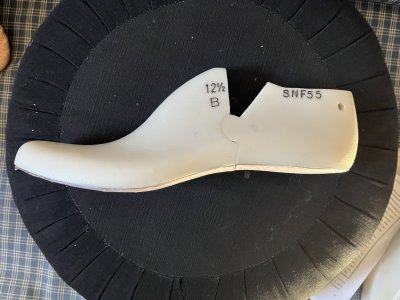
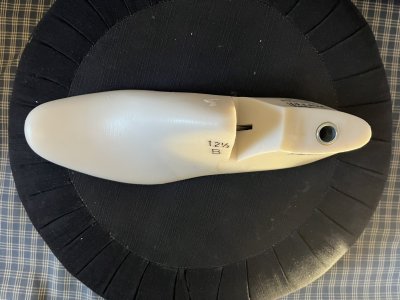
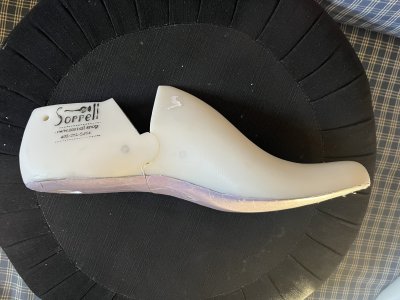
Shoe lasts used in factories are typically turned on CNC lathes from HDPE blanks, but custom and hobby shoe and boot makers are beginning to make lasts with FDM, especially in PETG. Here is an example: https://3dshoemaker.com/the-shoemaking-machine-has-arrived-bambulab-h2d/
The USA recently lost its final remaining domestic mass producer of shoe lasts. There are factories in central Mexico, but weight and bulk make shipping prohibitive. Besides, customization and fast iteration are especially important for custom and hobby makers making footwear for specific people, rather than for the mass market.
I'm sure if I had a printer at home I'd find other things to print, as well, but I will mostly be printing shoe lasts. Several hobby friends suggest PETG is the way to go.
What I'm Working With
I have never owned or directly used a 3D printer of my own, only designed and sent out parts as STLs to services like CraftCloud.
I am not a professional electronics engineer or technician, but have hobby experience building electronics projects, from barebone computers to old tube amplifiers to Arduino-based gizmos and Teensy-based computer keyboards. I have drivers, wrenches, sockets, soldering supplies, and so on, as well as access to a maker space.
On software, I've programmed computers since I was a kid, with lots of experience in open source, especially on Linux. Most of my work has been in Web and applications, not embedded or hardware, but I've done hobby projects with dev kits for a few microcontrollers and system-on-chips.
I'm based in Oakland, within the San Francisco Bay Area in Northern California.
Professionally, I help a lot of companies out of "open" communities try to do business. So I have a lot of sympathy for the trials, travails,and dramas of firms like Prusa. I also admire what Bambu have achieved, and have heard a lot of very confident recommendations to buy an H2S or H2D and be happy. But my heart does not exactly throb reading about unwelcome firmware updates, more license politics, &c. I'd rather reinforce, and maybe find a way to contribute back to, more open-hood, serviceable designs, even if features are fewer and jankiness relatively high. And I expect that's the better path to trod for learning, anyway.
How Terrible Is My Newbie Plan?
Having done some initial research, I'm leaning toward buying a FormBot V 2.4 kit for the 350 size. I'm expecting it might take me afternoons of, say, a month's worth of weekends to build.
I read that the 2.4 is in some respects trickier to build and set up than the Trident, but also that the flying gantry may improve precision and accuracy on large builds. The idea of a simpler, more straightforward design appeals to me, but going for the larger size, and planning to print perhaps relatively heavy objects, I'm guessing the benefits of the flying gantry could complement the large build volume choice. Or perhaps that's completely irrelevant for me, given the relatively low level of precision shoe lasts require.
I am slightly worried about choosing the more difficult design as my first 3D printer build, but perhaps haughtily guess that I can muddle my way through, based on prior experience in other projects.
I suspect that I may eventually benefit from a wider 0.6 or even 0.8 mm nozzle for efficiency, but would plan to put that off and print with the stock 0.4 to start. I've read the same advice to start stock and hack from there in a few places. I've certainly given that good advice to others, for other kind of projects, so I'd commit to following it as I can. I'd deviate only in accepting whatever substitutes come in a readily available kit.
Thanks Again
If you've read this far, thanks! Any thoughts—terse or long, correcting or confirming—will be really appreciated. I'll be looking for ways to give back.
Motivation
My main motivation for building a 3D printer is to print "shoe lasts", the molds used to make boots and shoes. These are solid, organic shapes up to roughly 320 mm long for the largest common shoe sizes. Roughly millimeter precision would be ideal. Surface smoothness is important in using a last, but any off-the-printer finish that can be quickly smoothed by hand as a post-process step would be fine.
Shoe lasts used in factories are typically turned on CNC lathes from HDPE blanks, but custom and hobby shoe and boot makers are beginning to make lasts with FDM, especially in PETG. Here is an example: https://3dshoemaker.com/the-shoemaking-machine-has-arrived-bambulab-h2d/
The USA recently lost its final remaining domestic mass producer of shoe lasts. There are factories in central Mexico, but weight and bulk make shipping prohibitive. Besides, customization and fast iteration are especially important for custom and hobby makers making footwear for specific people, rather than for the mass market.
I'm sure if I had a printer at home I'd find other things to print, as well, but I will mostly be printing shoe lasts. Several hobby friends suggest PETG is the way to go.
What I'm Working With
I have never owned or directly used a 3D printer of my own, only designed and sent out parts as STLs to services like CraftCloud.
I am not a professional electronics engineer or technician, but have hobby experience building electronics projects, from barebone computers to old tube amplifiers to Arduino-based gizmos and Teensy-based computer keyboards. I have drivers, wrenches, sockets, soldering supplies, and so on, as well as access to a maker space.
On software, I've programmed computers since I was a kid, with lots of experience in open source, especially on Linux. Most of my work has been in Web and applications, not embedded or hardware, but I've done hobby projects with dev kits for a few microcontrollers and system-on-chips.
I'm based in Oakland, within the San Francisco Bay Area in Northern California.
Professionally, I help a lot of companies out of "open" communities try to do business. So I have a lot of sympathy for the trials, travails,and dramas of firms like Prusa. I also admire what Bambu have achieved, and have heard a lot of very confident recommendations to buy an H2S or H2D and be happy. But my heart does not exactly throb reading about unwelcome firmware updates, more license politics, &c. I'd rather reinforce, and maybe find a way to contribute back to, more open-hood, serviceable designs, even if features are fewer and jankiness relatively high. And I expect that's the better path to trod for learning, anyway.
How Terrible Is My Newbie Plan?
Having done some initial research, I'm leaning toward buying a FormBot V 2.4 kit for the 350 size. I'm expecting it might take me afternoons of, say, a month's worth of weekends to build.
I read that the 2.4 is in some respects trickier to build and set up than the Trident, but also that the flying gantry may improve precision and accuracy on large builds. The idea of a simpler, more straightforward design appeals to me, but going for the larger size, and planning to print perhaps relatively heavy objects, I'm guessing the benefits of the flying gantry could complement the large build volume choice. Or perhaps that's completely irrelevant for me, given the relatively low level of precision shoe lasts require.
I am slightly worried about choosing the more difficult design as my first 3D printer build, but perhaps haughtily guess that I can muddle my way through, based on prior experience in other projects.
I suspect that I may eventually benefit from a wider 0.6 or even 0.8 mm nozzle for efficiency, but would plan to put that off and print with the stock 0.4 to start. I've read the same advice to start stock and hack from there in a few places. I've certainly given that good advice to others, for other kind of projects, so I'd commit to following it as I can. I'd deviate only in accepting whatever substitutes come in a readily available kit.
Thanks Again
If you've read this far, thanks! Any thoughts—terse or long, correcting or confirming—will be really appreciated. I'll be looking for ways to give back.
